
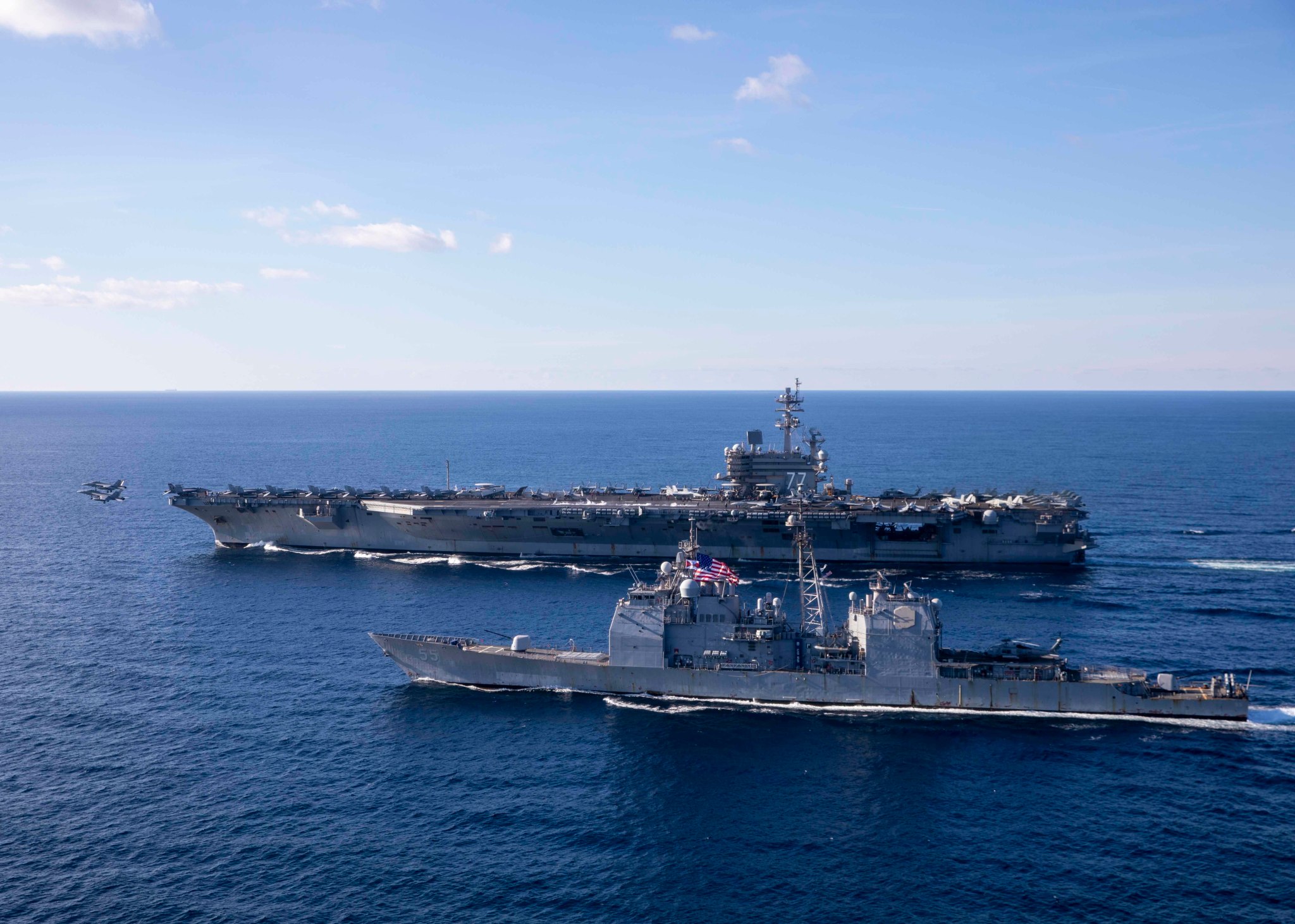

Families of sailors aboard the USS George H.W. Bush are preparing to spend the holidays without their loved ones after Navy leaders told them the carrier would not return home in time, extending a deployment that was initially expected to last six to seven months.
At a Nov. 9 town hall, families were told to prepare for a worst-case scenario of 12 months. If confirmed, it would mean another extension for a crew that has already seen its expected return date pushed back twice, according to families who attended the meeting.
The uncertainty surrounding the deployment’s length was evident even before the carrier left port. On March 31, Rear Adm. Alexis Walker, commander of Carrier Strike Group 10, acknowledged that the published deployment schedule did not guarantee when the sailors would return.
“There is a published length of deployment, but who knows how long it’s going to take, and when our job is done around the world, then we’ll come home,” Walker told reporters at Naval Station Norfolk.
For military spouse Shawna Berret, the uncertainty has reached her children.
“My 10-year-old is aware of the difficult conditions at sea and asks why Daddy doesn’t have enough food to eat. Do military children need to worry about their parents being hungry?” Berret told Military Times. “I’ve had to put my kids in counseling to help them cope with the now second extension of this deployment,” she added.
Some families say their concerns extend beyond the changing return date. They question the mission’s objectives and how much longer their loved ones may be kept away.
“The Secretary of the Navy told us that our loved ones will return home when Iran agrees to a non-nuclear Iran, and hearing those words made me sick to my stomach,” said Julie Fairchild, a Bush spouse who attended the town hall. “If Iran hasn’t agreed to not have a nuclear weapon for the past 47 years, why are our sailors responsible for ending it now?” she asked.
Another spouse said Adm. Karl Thomas, commander of U.S. Fleet Forces Command, told families he was not exactly sure what would happen in the next phase of the war with Iran.
“How does the Navy think that makes military families feel?” the spouse asked.
Another spouse said families had heard directly from Defense Secretary Pete Hegseth that he was responsible for extending deployments.
“We have heard directly from the Secretary of Defense that he is the one extending these deployments, and that he’ll do it again – he has no remorse,” the spouse told Military Times. “Hegseth has no problem keeping our sailors beyond their breaking point,” the spouse added.
At the town hall, acting Navy Secretary Hung Cao, Thomas and Vice Adm. James Kilby, the vice chief of naval operations, addressed families’ concerns.
Navy leaders acknowledged that the strike group’s future remained uncertain and that the decision about when it could leave the Middle East rested with Hegseth, according to reporting by The Daily Beast. Thomas told families that several outcomes remained possible, including a return to major combat operations, and said the decision was beyond his control.
Thomas also addressed concerns about food aboard the carrier. He acknowledged that the strike group was short on fresh food because produce shipped from Japan and the Philippines spoiled before reaching the ship. Fruit and vegetables, he said, did not last more than a week, leaving sailors with canned vegetables.
The concerns about the deployment’s duration come as Navy leaders say longer deployments are likely to remain standard for the next couple of years.
Master Chief Petty Officer of the Navy John Perryman said in October that sailors should expect deployments of 10 to 11 months, rather than the traditional seven months. Perryman said the Navy wants to give sailors more realistic expectations before they leave, rather than repeatedly extending deployments after they are underway.
The Bush Carrier Strike Group departed Norfolk on March 31 and spent 187 days at sea before arriving in Phuket, Thailand, on Oct. 4 for its first port visit of the deployment. The five-day visit gave sailors an opportunity for shore leave before the carrier returned to operations in the Arabian Sea.
Read the full article here