
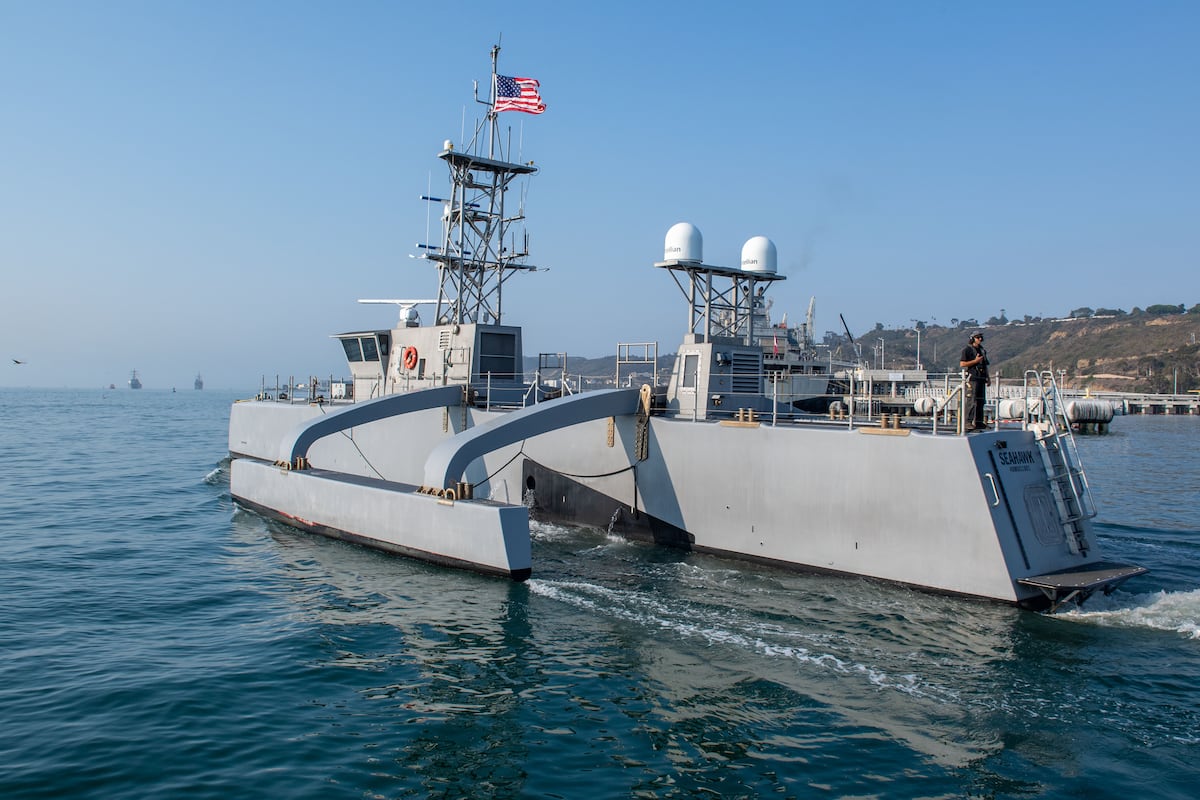

The U.S. Navy announced that it is procuring 30 medium unmanned surface vessels after seven companies competed for contracts as part of its new autonomous maritime robotics initiative.
The service awarded contracts to Galliano Marine Services, Huntington Ingalls Industries and Saronic Technologies after the three companies completed phase one of at-sea testing for its Medium Unmanned Surface Vessel Family of Systems program.
Sea Machines, Leidos, PacMar Technologies and Birdon also completed at-sea testing and competed for a contract but ultimately lost the bid to produce vessels for the Navy.
“Each agreement includes the procurement of 10 MUSVs, at an average procurement cost of $40 million per vessel,” the Navy said. “The first MUSVs are scheduled to be delivered to the Navy prior to the end of fiscal year 2027.”
Though they didn’t make the final cut, Sea Machines, Leidos and PacMar Technologies were awarded $15 million for completing at-sea testing and will now be hosted on the Defense Department’s drone marketplace, where they are eligible to receive other contracts.
Acting Navy Secretary Hung Cao praised the contract awards as a sign that the Navy was prioritizing moving quickly to modernize its fleet.
Phase one at-sea testing evaluated MUSV’s ability to understand a maritime environment, maneuver unassisted by an operator and deploy at sea for long intervals.
The service announced the start of MUSV phase two testing on Sept. 23 to continue the procurement of autonomous systems.
The Navy is currently attempting to expand its unmanned surface vessel fleet from four to 30 vessels by 2030 in the Indo-Pacific.
The service announced a MUSV marketplace in March, which replaced the Modular Attack Surface Craft program.
Several companies were already competing for a contract for that program when it was shut down in favor of the marketplace.
Blue Water Autonomy and Saildrone, which initially participated in the MASC program but were not chosen to continue participating in the MUSV program, sued the Navy after alleging they were excluded unfairly.
The March marketplace solicitation asked for MUSVs capable of traveling 2,500 nautical miles at 25 knots while carrying a 25-ton load on the payload deck in moderate conditions.
The Navy’s push to accelerate autonomous systems research, development and solicitation follows a June report from the U.S. Government Accountability Office that said the Navy needed to quickly reimagine the way it invested in robotic systems to address the fleet’s urgent needs.
Rebecca J. Gassler, who previously spearheaded the Navy’s robotic and autonomous systems program, was fired on Aug. 5 after serving only 8 months.
Christopher Miller took over for Gassler and assumed duties as acting Direct Reporting Portfolio Manager for Robotic and Autonomous Systems, a role created on the same day Gassler was removed.
Miller, speaking at a media roundtable on Tuesday, said phase two testing will apply laxer requirements than phase one.
“Obviously with phase one, there were some more challenging requirements that they had to meet and so I’m trying to back off of those so that I can have a healthy competitive industrial base,” Miller said.
Specifically, phase two doesn’t set a high speed requirement for MUSVs and it doesn’t require refueling at sea, Miller said.
Riley Ceder is a Navy reporter at Military Times, where he covers issues directly affecting service members and their families, as well as breaking news.
Read the full article here