
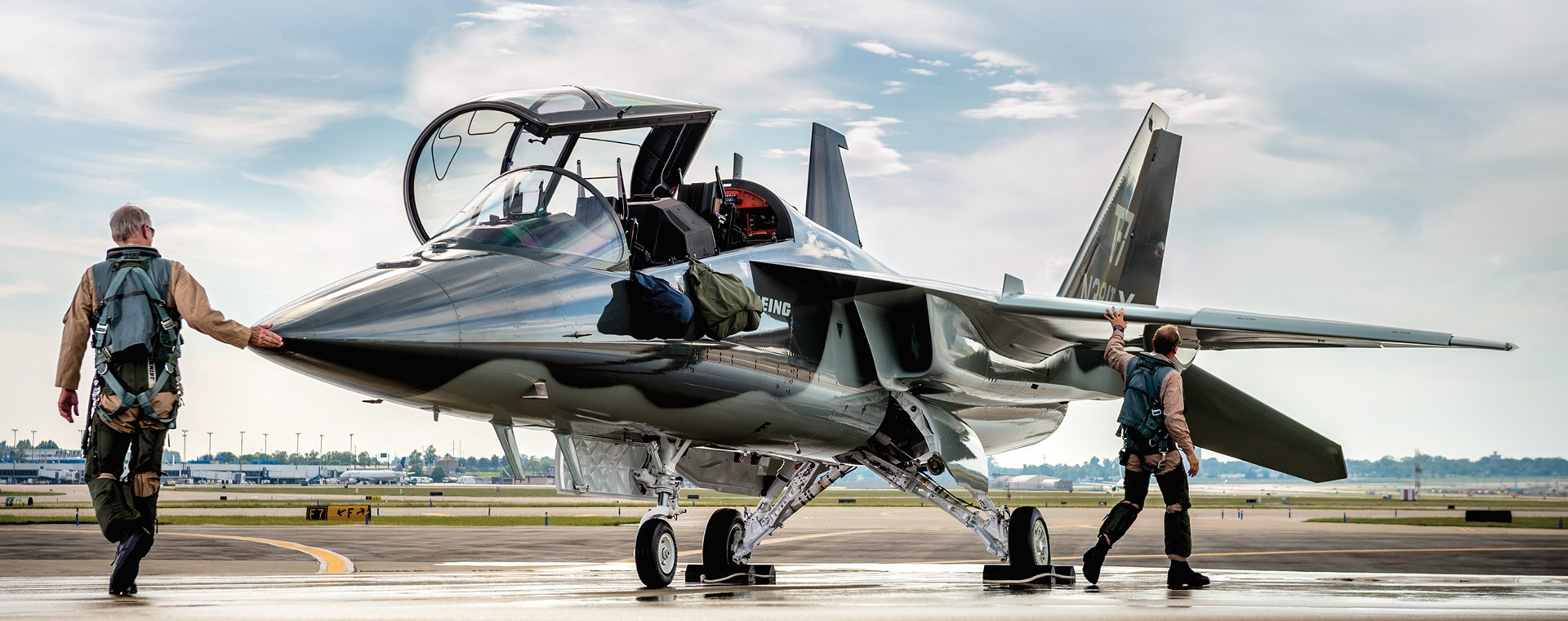

As the Air Force awaits the formal entry into service of its new T-7 Red Hawk trainer jet as soon as next year, the general in charge of all the Air Force’s training programs cited an unusual misgiving: that the new plane might make it too easy on students.
Speaking at the Mitchell Institute for Aerospace Studies on Monday, Lt. Gen. Clark Quinn, head of Air Education and Training Command, described an opportunity he’d had to fly the trainer at Edwards Air Force Base, California, earlier this year.
“It was a very restricted flight envelope, and I’m not saying that I am in any way a great pilot, but I will say that my second landing in the T-7 was probably better than my average landing in the T-38; it’s just a relatively easy-to-fly airplane,” Quinn said, referencing the Air Force’s current T-38 Talon, which entered service in the early 1960s.
“There actually was a part of me that thought maybe this is too easy to fly, because I want to test some skills early in pilot training,” he added. “But the amount of information … decision-making, systems management, is something that the airplane will be able to do for us.”
While Quinn is responsible only for pilot training and said he had yet to receive the formal flight envelope or operational boundaries of the aircraft — parameters that could affect when the trainer reaches operational capability, as the Air Force will then need to train instructors accordingly — he suggested there would be opportunities to use training time in new ways.
“If we assume that we spend a third of the T-38 syllabus just teaching pilots how to not break the airplane or hurt themselves — we’re doing stalls and no-flap approaches and all of the other things that make that aircraft so challenging to fly — that’s a third of the syllabus, what can I replace it with,” he said. “So we’re actively looking at that.”
Also new for the T-7 is a more advanced simulator, Boeing’s Ground Based Training System, which features, among other things, “a virtual wingman” that can simulate formation flight before trainees ever leave the ground. Yet having those additional simulated training capabilities raises important new questions about what training should remain live, Quinn noted.
“In the earliest portions of the pilot training pipeline, I don’t know how much live, virtual, constructive will actually play a role. I want you flying formation against another actual airplane; I don’t want you flying formation against a virtual constructed entity,” he said. “As we get closer to the end, into what would have been intro to fighter fundamentals or whatever else it’s going to be called, fighter-bomber fundamentals, that’s where I think we actually have the ability to move sorties from the formal training units into the T-7.”
That latter part of training, he indicated, is where the additional proficiency provided by the advanced simulator may make the most difference, potentially reducing the number of basic fighter maneuvers trainees need to complete in fighter jets like the F-16 Fighting Falcon after they graduate from the trainer jet.
“If I’ve got T-7 folks that are out there flying an air-to-air sweep with constructed strikers on the ground, that’s something that we never would have been able to do in pilot training,” he said. “In fact, it was something that 10 years ago we struggled to do in frontline operational units. But I will have that ability to bring some of those skills into the pilot training pipeline.”
The Boeing-Saab Red Hawk was selected in 2018 to replace the aging T-38. A Government Accountability Office report published in July raised the prospect that testing delays would push back a decision to greenlight full-rate production from 2027 to 2029. Quinn said on Monday that the projected 2027 timeline to achieve initial operational capability was still the target, but acknowledged “risk” in reaching that timeline.
But in light of the anticipated capability and flight ease of the T-7, he said officials are already considering shifting some of the training load of the Air Force’s T-6 Texan trainer to the Red Hawk.
“If I go into the future a decade or 15 years, and we start thinking about having to recapitalize the T-6, that may be a really natural point — if we’re going to buy more trainers, maybe we buy more T-7s,” he said. “I think it’s just premature to make that decision until I get a few more aircraft on the ramp. I actually get my instructors qualified in it, and frankly, I get a couple of students into it to see how they react, and at that point we’ll make decisions.”
Read the full article here