
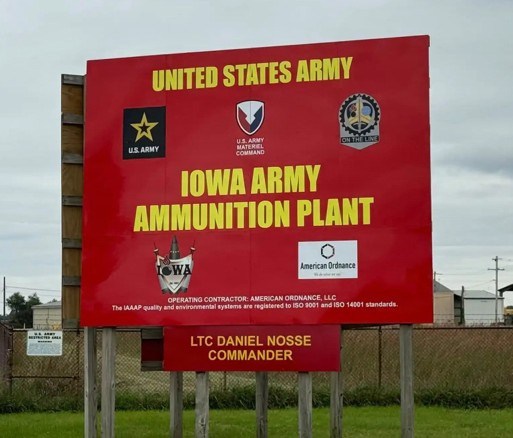

The Army has delayed the detonation of an unstable ammunition reserve at an Iowa plant for the second time, the Army announced this weekend, pushing the polarizing move until Wednesday.
Originally scheduled for last week, the service postponed the blasts on Friday until Monday, then rescheduled the operation again. The Army, citing concerns of an uncontrolled explosion, intends to detonate more than 9,000 pounds of degraded lead azide stored at the Iowa Army Ammunition Plant.
The new date will “allow for optimal weather conditions and all mitigation measures to be emplaced,” the service said on Sunday on social media, adding that more information would follow.
Lead azide is a highly sensitive compound used in military detonators and blasting caps. The facility makes medium- and large-caliber ammunition for the Department of Defense.
Lead is extremely poisonous and, according to the National Institute of Environmental Health Sciences, there is no safe level of the substance in a person’s bloodstream. Lead can have especially devastating — and sometimes permanent — impacts on pregnant people and young children’s development.
The community has protested the decision and a bipartisan group of lawmakers are pushing the Army to delay detonation until it can look into alternative disposal methods.
The Army’s environmental assessment said that the compound could not be chemically degraded, which is an alternative to the blasts, because the lead azide is so sensitive to movement that it might explode unexpectedly.
“The chemical neutralization process requires significantly more ‘hands-on’ time and physical manipulation of the drums by personnel over a prolonged 7- to 22-day period, drastically increasing the probability of accidental, fatal detonation during handling,” the Army assessed.
According to information released earlier in the month, the Army plans to detonate the lead azide barrels inside concrete bunkers covered with earth and surrounded by barriers. The Army also plans to soak the soil above the bunkers to reduce the amount of contaminated dust that spreads after the blast.
Although the U.S. Environmental Protection Agency issued an emergency permit for the detonation, the Army predicted higher levels of lead particles in the air after the blast. The EPA permit requires the service to sample areas in the modeled blast radius afterward.
A map of projected lead dispersion released by the Army Wednesday showed impacts stretching dozens of miles. Air dispersion projections showed contamination stretching north over time.
Officials have not released a count regarding the number of communities that may be impacted by the planned detonation, but there are nearly 400 residents in nearby Middletown and it is estimated that thousands more could be affected by the dangerous plume.
According to Iowa’s Health and Human Services, the Army plans to update its maps “Six hours before the detonation and hourly thereafter until detonation,” as well as “Following the event, with a final estimate of the impacted area.”
Iowa Governor Kim Reynolds said state agencies were preparing for the blasts.
“Protecting the health and safety of Iowans is the state’s highest priority, and agencies have been working throughout the week to prepare for the planned detonation at the Iowa Army Ammunition Plant,” she said in a statement on X. She also added a link to resources for affected communities.
Read the full article here