

A United States Navy submarine sunk an Iranian ship with a single torpedo this week as the frigate was transiting the Indian Ocean, marking the first such kill by a U.S. submarine since World War II, the Pentagon confirmed on Wednesday.
Speaking to reporters at the Pentagon alongside Chairman of the Joint Chiefs of Staff Gen. Dan Caine, Defense Secretary Pete Hegseth acknowledged the strike while discussing updates surrounding ongoing combat engagements in Iran, dubbed Operation Epic Fury.
“Yesterday, in the Indian Ocean … an American submarine sunk an Iranian warship that thought it was safe in international waters,” Hegseth said. “Instead, it was sunk by a torpedo. Quiet death. The first sinking of an enemy ship by a torpedo since World War II.”
Caine also confirmed the action on Wednesday, noting a fast attack submarine off the southern coast of Sri Lanka “sunk an enemy combatant ship using a single Mk-48 torpedo to achieve immediate effect, sending the warship to the bottom of the sea.”
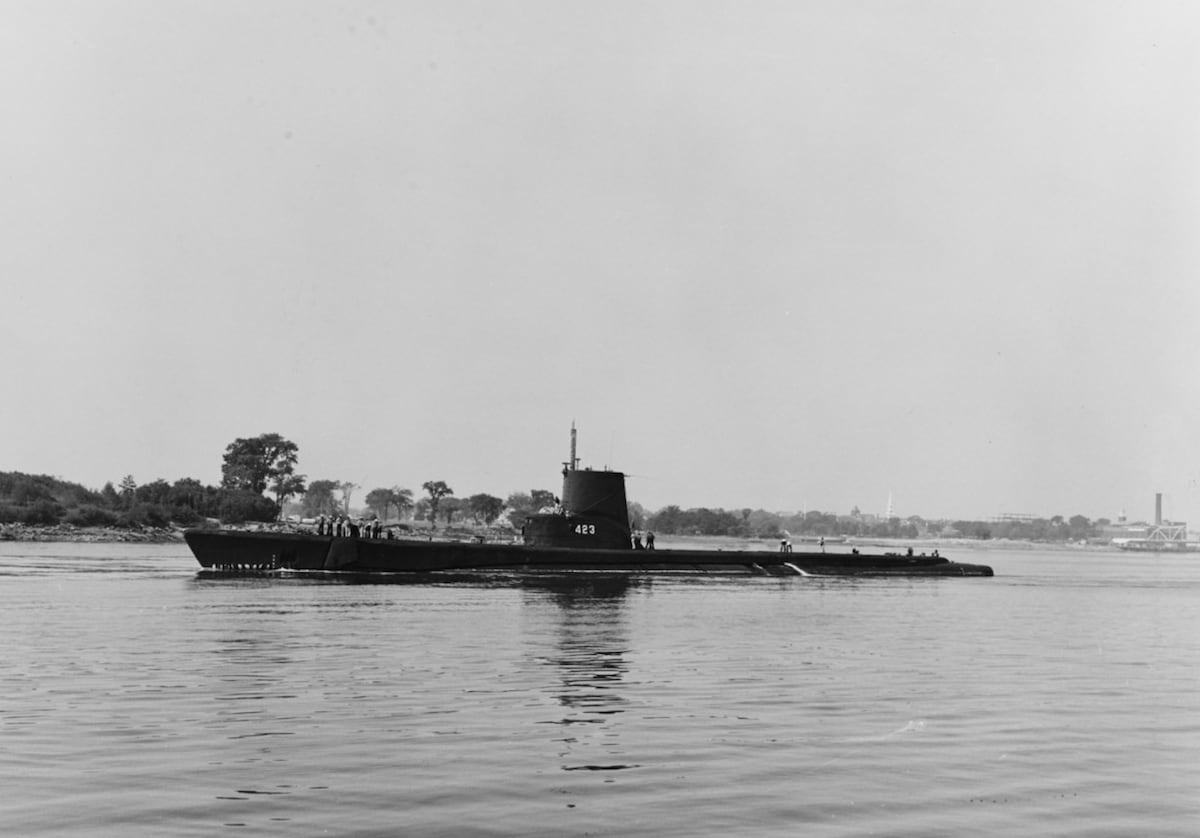
The last U.S. boat to notch a confirmed torpedo kill on an enemy vessel, meanwhile, was the Tench-class submarine USS Torsk, which sent two Japanese coastal defense frigates below the waves on Aug. 14, 1945, one day prior to the country’s surrender in the Pacific.
Commissioned on Dec. 16, 1944, Torsk began its first war patrol under the command of Comdr. Bafford E. Lewellen in March the following year.
The submarine, however, did not find much action initially. By 1945, the U.S. had all but crippled Japanese shipping.
A postwar Joint Army-Navy Assessment Committee found that by August 1945, “American forces had sunk 611 Japanese naval vessels, totaling 1,822,210 tons; and 2,117 merchant vessels, of 7,913,858 tons. Of that, submarines contributed a huge part, accounting for 201 naval vessels (540,192 tons) and 1,113 merchant vessels (4,779,902 tons) — or about 33% of naval vessels by number and 30% by tonnage, and 52.5% of merchant vessels by number and 60% by tonnage.”
By August, “Lewellen’s Looters” were just beginning their second — and what would be their final — war patrol.
After spending the first two days of the month at Guam the submarine set course for the Sea of Japan, where the Torsk’s entry into the WWII record books would be cemented.
On the morning of Aug. 14, the day after Torsk took out a small freighter, the submarine was operating off the coast when it spotted a 745-ton “Kaibokan”-class patrol escort vessel.
Torsk promptly found its target with a Mark 28 torpedo, bending “the stern of the frigate up to a 30-degree angle” before it sank soon after, according to Naval History and Heritage Command.
Around noon that same day another enemy frigate appeared in Torsk’s sights.
“Continuing her aggressive action, Torsk fired a Mark 28 torpedo at the frigate which had already detected the submarine’s presence,” NHHC notes. “Comdr. Lewellen then initiated deep submergence procedures and ordered the crew to rig for silent running. After a tense five minutes, she reached 400 feet and there she launched another torpedo, this time the new acoustic Mark 27.
“Almost immediately, a loud explosion announced that the first torpedo had found its mark, and a minute later a second explosion sounded, followed by strong breaking up noises. The secret new torpedoes had proven their worth in battle.”
For seven more hours the submarine and its crew remained submerged, held down by enemy planes and patrol vessels before at last resurfacing and heading for the Noto peninsula off the coast of Japan.
The following day, Emperor Hirohito announced Japan’s unconditional surrender.
The Torsk’s sinking of the enemy vessel marked the last U.S. Navy submarine torpedo kill for eight decades — until U.S. actions against Iran on March 3, 2026.
The identity of the fast-attack boat which carried out the action this week was not revealed, as is custom for operational security surrounding submarine operations.
Claire Barrett is an editor and military history correspondent for Military Times. She is also a World War II researcher with an unparalleled affinity for Sir Winston Churchill and Michigan football.
J.D. Simkins is Editor-in-Chief of Military Times and Defense News, and a Marine Corps veteran of the Iraq War.
Read the full article here