
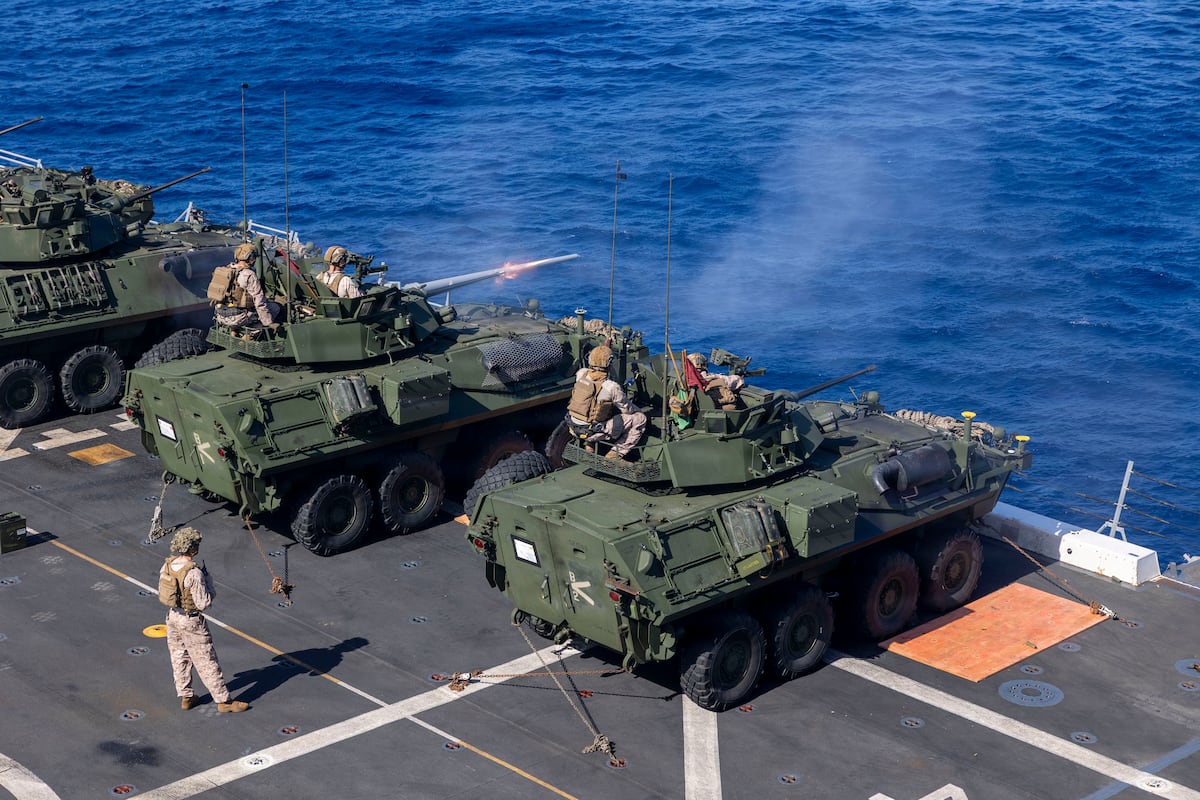

The U.S. Marine Corps is looking for 360-degree camera systems to fit on the LAV-25 and other armored vehicles.
The goal is to allow crews to operate their vehicles – and enjoy full situational awareness – even while buttoned up with the hatches closed.
The service is looking for fully integrated, turnkey systems that provide “complete situational awareness” and enable crews to operate the vehicle from within the hull with all hatches and doors closed on land, according to the Request For Information published by the Program Manager Light Armored Vehicles. The deadline is June 18.
PM LAV envisions a system with a minimum of four cameras and a maximum of 10 that merge into a single video stream to provide a combined 360-degree view.
The system should include infrared or thermal imaging for low-light conditions, a zoom feature, high-resolution video, such as 1080p or 4K, and accurate capture of colors “for maneuvering, local security, and identification of personnel, obstructions, and obstacles.”
While the RFI specifically describes the project as a “survivability upgrade [that] is intended to significantly enhance LAV platform,” it also mentions amphibious platforms like the Amphibious Combat Vehicle, as well as the Advanced Reconnaissance Vehicle. The ARV will replace the LAV-25, which was first deployed in the early 1980s.
The Marine Corps seems particularly concerned with allowing crews to close their hatches when their vehicles are in the water.
As the U.S. Navy’s Naval Safety Center noted with the Amphibious Assault Vehicle, “water will make its way into the vehicle, especially when operating with the top hatches opened. Reduce extra strain on the systems and prevent unnecessary water intake by ensuring everything that can be water-tight is.”
The RFI asks contractors to “describe how their 360SA systems support operations in maritime and littoral environments, including during swimming operations, ship-to-shore maneuvering, and low-visibility coastal conditions.”
This includes full situational awareness even while fully or partially submerged, and “optimized sensor layout for low-profile hulls and swimming posture.”
The camera system should also allow “detection and classification of surface vessels, navigation lights, and day shapes for collision avoidance.”
Crews must be able to use the cameras to “assess sea state, wave patterns, and visibility conditions that may affect swimming.” And, it should feature “real-time tracking and ranging of contacts in fog, surf, and low-light conditions.”
Companies are asked to provide evidence of prior deployment or testing in maritime or amphibious environments. The cost should be no greater than $160,000 per vehicle, including all cameras, displays, software and other components.
Michael Peck is a correspondent for Defense News and a columnist for the Center for European Policy Analysis. He holds an M.A. in political science from Rutgers University. Find him on X at @Mipeck1. His email is mikedefense1@gmail.com.
Read the full article here