

Fifty years ago, a U.S. Air Force colonel named John Boyd offered a profound insight into why battles are won or lost.
His famous Observe, Orient, Decide, Act — or OODA — Loop described the mental cycle by which combatants, from fighter pilots to generals, assess and react to a constantly changing situation.
Those with a faster OODA Loop could exploit opportunities while their befuddled opponents struggled to understand what was going on.
Germany crushed France in 1940 largely because of a sluggish French command system that was always one OODA step behind the swift panzer divisions. More recently, OODA might explain why tactically rigid Russian tank columns were decimated by outnumbered but agile Ukrainian troops in 2022.
Had the Soviets invaded Western Europe during the Cold War, NATO would have relied on OODA — plus airpower and more advanced weapons technology — to stop the Soviet steamroller.
To the troops watching waves of Soviet tanks roll into the Fulda Gap or the North German Plain, OODA would have been just a buzzword. But NATO needed every advantage it could get to compensate for superior Soviet numbers and firepower.
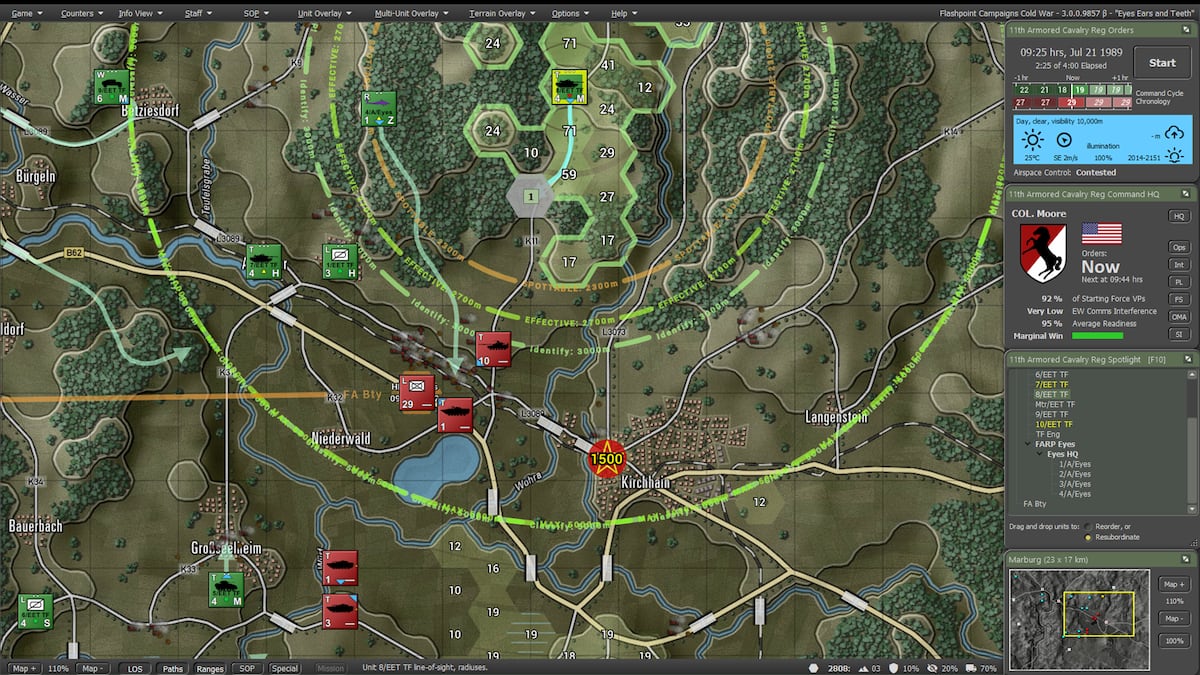
Flashpoint Campaigns: Cold War, published by Matrix Games, is a computer wargame that depicts a hypothetical Warsaw Pact invasion of West Germany in 1989.
But it is more than just another World War III wargame. Flashpoint Campaigns is the OODA Loop gamified. In fact, the game comes in two versions: the regular game for armchair generals, and a professional edition for real soldiers.
Flashpoint Campaigns is a 2-D map game, with NATO platoons and Warsaw Pact companies waging battalion- to division-sized battles. Set in the twilight of the Cold War, much of the hardware — such as Abrams and T-72 tanks, and Bradley and BMP infantry fighting vehicles — are still around today.
Players issue orders to their troops, such as movement, direct fire, calling in artillery and airstrikes, combat engineering operations and resupply. For example, a tank platoon can be ordered to head to a crossroads via a series of designated waypoints along the route.
Units can be given standard operating procedures, or SOPs, such as determining at what range to open fire, when to change firing position and when to retreat. Enemy units are usually invisible until spotted. With Late Cold War weapons so devastating, combat is deadly and proper concealment and reconnaissance a must.
After a player finishes issuing commands, they can hit the start button. A game clock then appears and a certain number of minutes elapse, during which units try to fulfill orders.
It all sounds like a straightforward process — until OODA intervenes.
Unlike many wargames, players in Flashpoint Campaigns can’t give orders to their troops at will. Instead, only at certain intervals does the game clock pause and allow commanders to issue fresh orders. This reflects the time it takes for the command system to collect information, analyze it, reach a decision and pass a new order to subordinates.
Like an object in motion in Newtonian physics, units will try to execute their last set of orders until new instructions arrive. That tank platoon heading down the road toward a village will keep going toward that village until told otherwise, even if the tactical situation has changed.
This is where NATO’s OODA advantage kicks in. The NATO player might have to wait, say, for 14 minutes of game time to elapse before issuing fresh orders. For the Soviets, the delay might be 23 minutes, or about 50% longer.
This means that NATO will have more opportunities to give new orders than the Soviets do. In turn, this means NATO troops can more quickly react to new threats such as enemy forces on their flank, or exploit discovery of a gap in the enemy’s lines.
It also means that NATO can be more flexible in its planning, rather than having to anticipate the tactical situation far in advance.
“We all know what happens when plans make contact with the enemy,” Robert Crandall, president of On Target Simulations, which designed Flashpoint Campaigns, told Military Times. “NATO spent considerable efforts to train for what happens after that contact and to respond faster than their counterparts. This could let them operate inside the Warsaw Pact command loop and outmaneuver them.”
But even NATO has OODA problems in the game. The presence of electronic warfare, in which the Soviets invested heavily, lengthens the interval before a player can give orders. Units engaged in combat will require 50% more time to react to new orders.
And commanders who send too many orders to their troops will receive an unpleasant surprise: too much radio traffic reveals the location as a headquarters, marking it for an artillery or airstrike.
Indeed, some U.S. Army experts today worry American command posts are so chatty that they will be targeted in wartime.
As battles progress in Flashpoints Campaigns, and units takes losses and headquarters are disrupted, command delays will inevitably lengthen for both sides.
Clausewitz’s “friction of war” will become an impediment, though a bit less so for NATO. Commanders on both sides will have to grit their teeth and accept that they can’t control their troops as they would like to.
Would NATO’s tighter OODA Loop have been enough to defeat the Soviets?
“One of the nicest compliments the game received came from a former Warsaw Pact officer who said he played the game using strict Warsaw Pact doctrine and won,” Crandall recalled.
“If the Warsaw Pact player has figured things out correctly, his initial plan will not have needed much, if any, adjustment and just rolls along at maximum speed. His opponent will be wrong-footed and at the mercy of the OODA Loop to react in time. With the fast-moving, hyper-lethal forces of 1989, good luck with that.”
In some ways, Flashpoint Campaigns is a memorial to another era.
The year 1989 was the twilight of 20th Century mechanized warfare. With the threat of drones paralyzing battlefield maneuver in the Ukraine War, discussing OODA’s influence on tactics seem almost quaint.
And yet, there is a reason why there is a global arms race today to develop smarter AI, quicker kill chains between sensors and weapons, and tightly networked forces that can act faster than the enemy.
Every year, the OODA Loop seems to tighten, with less margin to fall behind. As OODA reminds us, time is too precious a commodity to squander.
Michael Peck is a correspondent for Defense News and a columnist for the Center for European Policy Analysis. He holds an M.A. in political science from Rutgers University. Find him on X at @Mipeck1. His email is mikedefense1@gmail.com.
Read the full article here